
In the immuno-oncology therapeutics arena PD-L1 is a hotly investigated target both pre-clinically and in the clinic to harness the immune system to fight cancer. This protein has a highly complex biology, distributed in multiple cellular compartments although it’s presence on the cell surface of cancer cells and binding to the PD1 receptor on T cells to shut off immune signaling is a prominent reason for pathology. Targeting PD-L1 protein with small molecules has been challenging in the clinic, including poor efficacy, toxicity and drug resistance, since 120 proteins are known to regulate PD-L1 expression in cells. VistaraBio’s work yields some clues as to why this might be the case and suggests a path forward.
The diagram below, based on our findings shows a Proximity PTM Map of post translational modifications (PTMs) of 113 proteins associated with PD-L1 (PD-L1-Regs). While PD-L1 itself is known to harbor many PTMs, those of proteins that it complexes with tell the story of where in the cell PD-L1 may be localized (or not), which can vary with changes in the cell cycle, in cancer cells, the state of the tumor microenvironment, with therapeutic treatment, environmental factors or for other reasons.
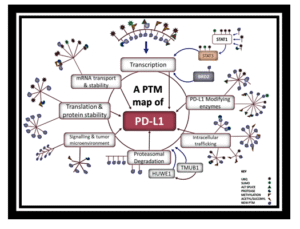
The map also depicts additional layers of complexity arising from mutations in PD-L1-Regs, or changes to their biology from toxic challenge or cytokines. Observing them in cancers may not only explain the location-dependent functions of PD-L1 but also provide insights into disease causing mutations and interventional points with drugs on a next-of-kin basis.
VistaraBio’s generated proximity map is a rich resource hitherto unknown/elusive for breaking down the complexity of interactions and zeroing in on hotspots within it for clinical applications. VistaraBio has made headway with this aspect. Serendipitously, the ubiquitination sites in 15 PD-L1-Regs studied on a sample basis were associated predominantly with Adenocarcinomas of the lung and colon, but not other types of cancer, suggesting that hormonal signaling may stress the already prevalent mutation burden, be in the path of disease manifestation, or help to maintain the cancerous state.
Curiously, the PD-L1-Regs which show a high prevalence of mutations in Adenocarcinoma are intricately involved with PD-L1 functions – it’s transcription, the stability of its mRNA, the ability of the protein to translocate to the nucleus or appear on the plasma membrane. These findings pave the way for in vitro studies aimed at location-specific targeting of PD-L1, including combinations. The reagents, peptides, and tools created by VistaraBio will help separate the wheat from the chaff in the map and select out the most promising candidates to translate into the clinic after validation.
Although preliminary, the findings offer the attractive prospect that a well-validated PD-L1 pathway component which narrowly targets PD-L1, instead of PD-L1 itself, can be explored as a clinical candidate. Consequently, in this vein a key aspect is the potential of applying degrader technology as a therapeutic modality in preference to the small molecule inhibition strategy which is currently used. Equally important, the next-of-kin targeting strategy may overcome tradeoffs arising from the biological and functional pleiotropy of PD-L1, if the surrogate clinical target bears a smaller biological footprint. This can give rise to potent, safer drugs stratified with different cancer types.